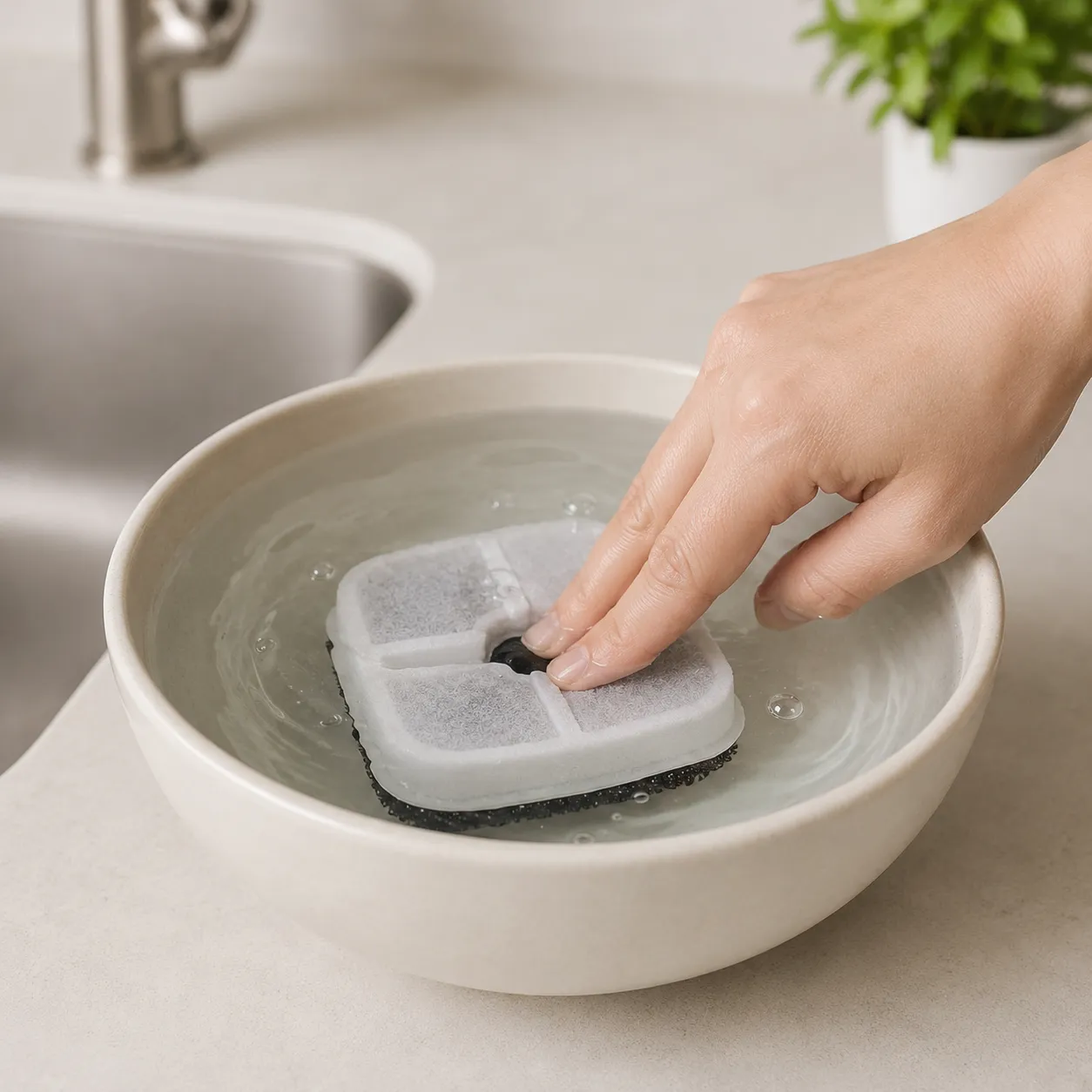
If you're seeing a pink film around the bowl, the filter tray, or the pump, that's your cue for a real cleaning, not just another top-up. That pink residue is often linked to Serratia marcescens, though color alone won't tell you exactly what's growing there.
You probably won't stop every trace of slime for good. But staying on top of cleaning, keeping the water fresh, and not ignoring the hidden wet spots goes a long way toward keeping it from taking hold.
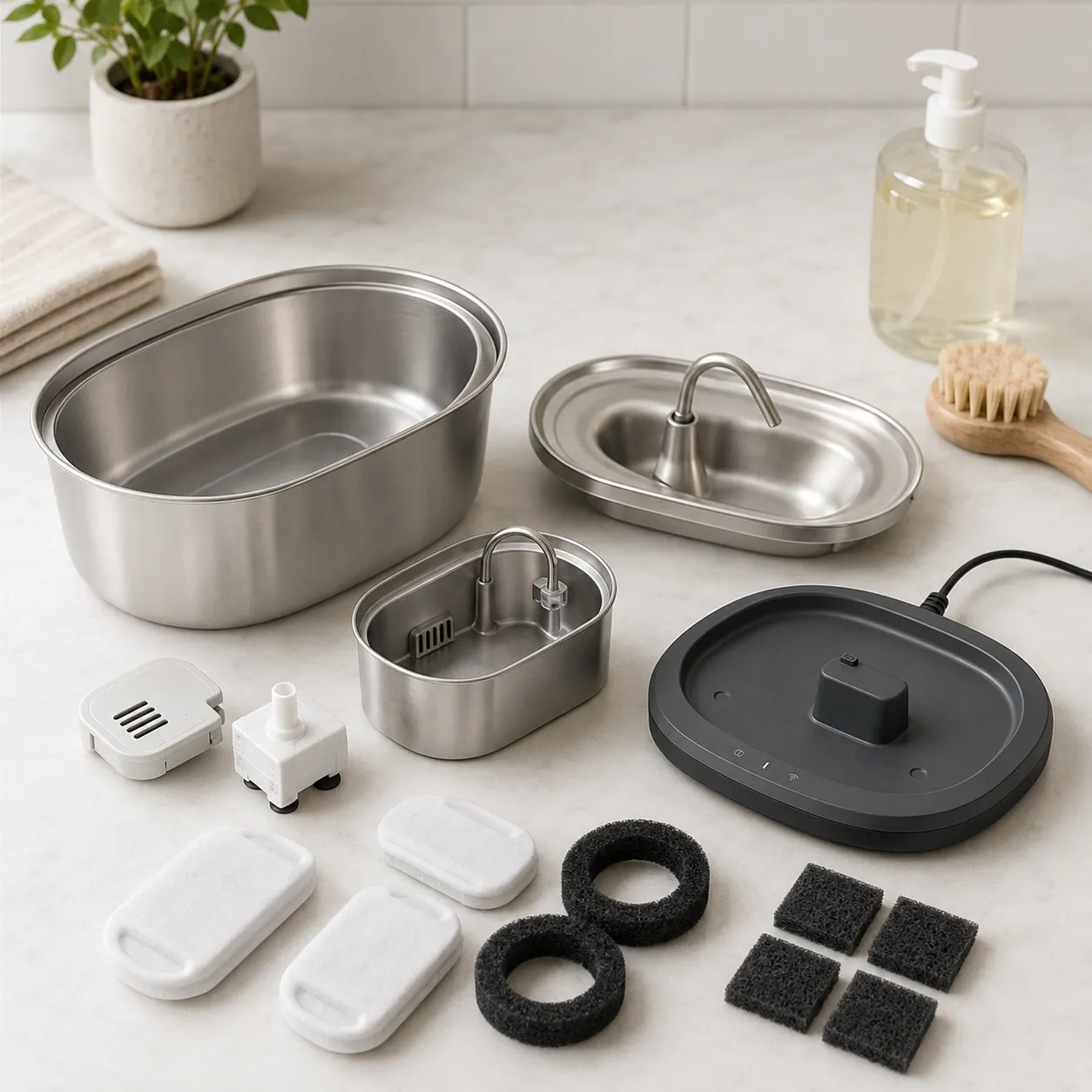
What you'll need
- Mild dish soap (check that it's approved for your fountain)
- A soft cloth or a nonabrasive brush
- A small brush for pump openings and tight crevices
- Clean water for rinsing
- Your owner's manual
- White vinegar, but only if the manual gives you a vinegar-cleaning method
A routine that actually slows buildup down
1. Wash the drinking surface often
If your manual allows it, wash the exposed bowl or tray daily. Dump the old water, scrub the surface, rinse, refill with fresh water. That's it.
Just adding more water raises the level — it doesn't touch the film stuck to the tray or tank.
2. Take the whole thing apart for a deeper clean
Switch the fountain off and unplug it before you touch the pump or tank. If the design allows it, lift the tank off its base. Keep the plug, adapter, base, battery compartment, and any electrical contacts away from water entirely.
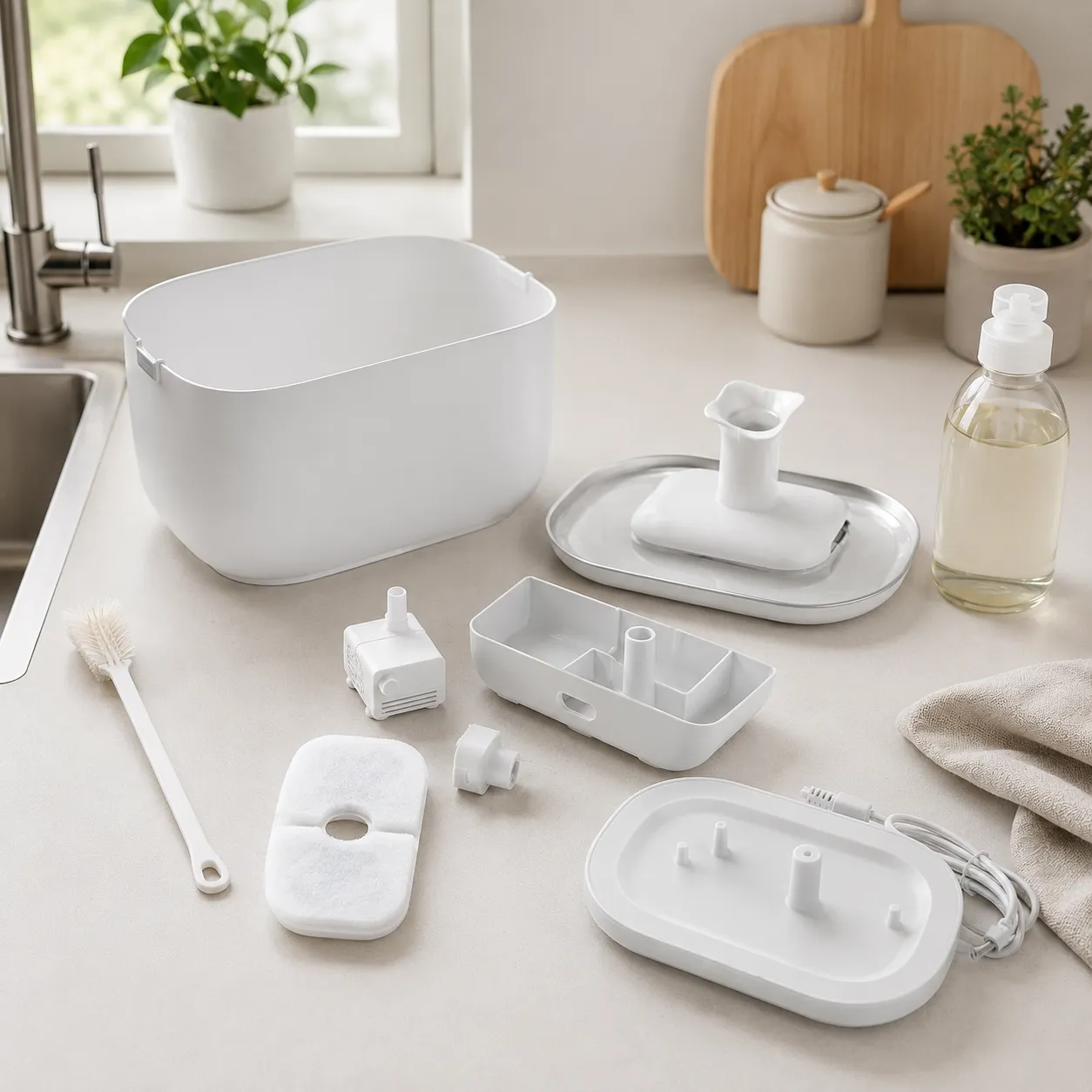
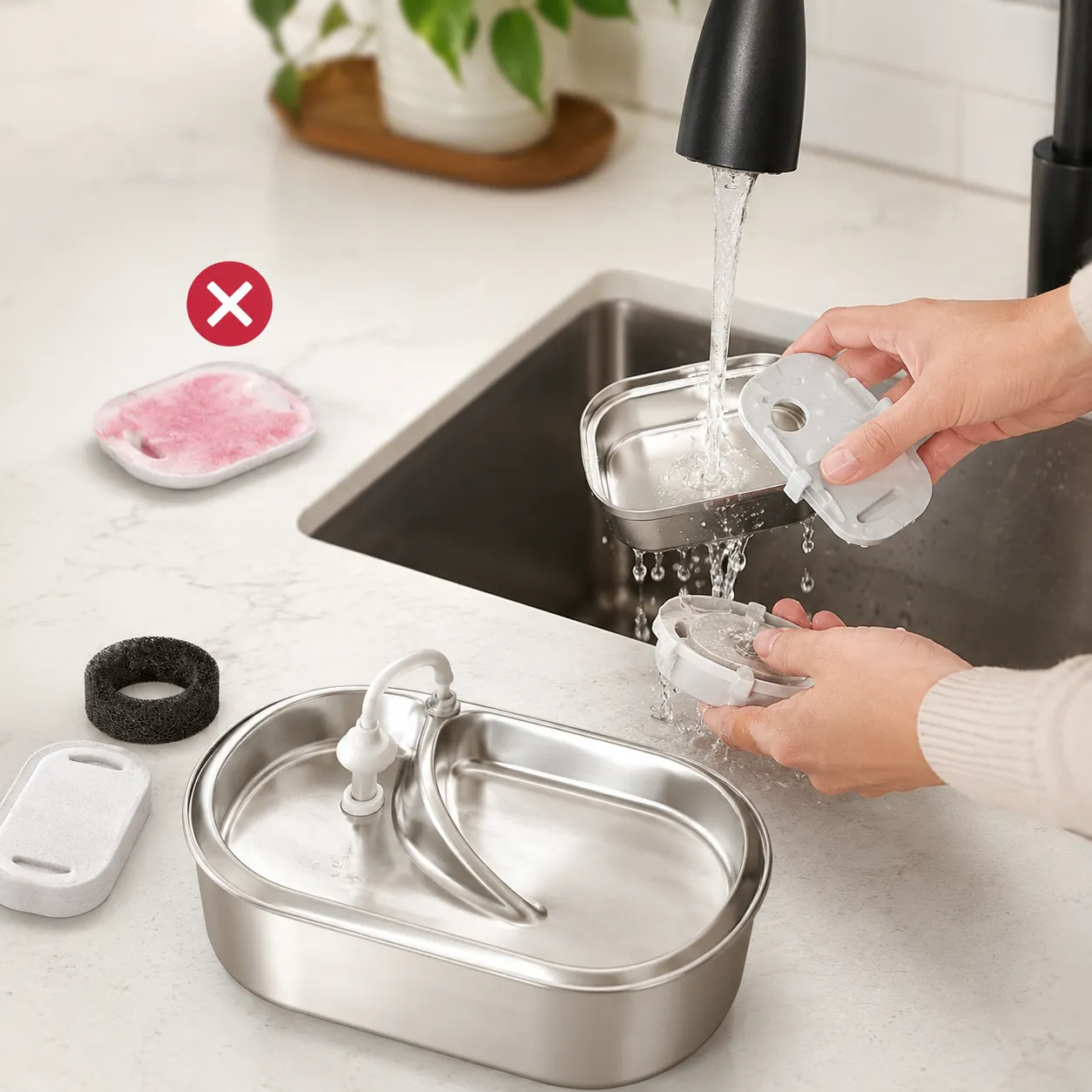
Take out the filter, then separate whatever washable pieces your manual shows — this might include the lid, tray, filter housing, tubes, pump cover, or impeller. Don't force anything apart; some trays and housings just aren't meant to come off.
3. Get into the spots a quick wipe never reaches
Warm water and mild dish soap (again, only if your model allows it) on every removable part. Pay special attention to corners, seams, the underside of the tray, the filter compartment, intake openings, and the pump chamber itself.
Hair and gunk tend to collect behind the pump cover and around the impeller. If you only ever clean the visible bowl, those spots stay untouched — and that's usually where trouble starts again.
4. Rinse thoroughly, then reassemble
Keep rinsing until there's no soap or cleaner residue left. Put the pump and fountain back together, and double-check that the covers, tubes, and impeller are seated properly before you plug it back in.
Don't assume the pump, filter, or any power-related parts are dishwasher-safe — that varies a lot by model.
5. Never leave a wet filter sitting in a fountain that's switched off
Planning to leave the fountain off for a while? Don't leave the filter sitting there in stagnant water. Pull it out and follow whatever disposal or replacement steps the filter maker recommends.
A filter isn't a stand-in for actually washing the tray, housing, pump, and narrow water channels — it just can't do that job.
Pink film vs. white mineral buildup — they're not the same thing
Pink slime or biofilm calls for physical cleaning: taking things apart, washing, scrubbing, rinsing well.
White or chalky deposits, on the other hand, are usually mineral scale. Some fountain makers approve a diluted white-vinegar solution for that, but the exact concentration and soaking time depend on the model. Only use vinegar if your manual says so, and rinse until you can't smell it anymore.
Don't treat vinegar like a universal disinfectant, and don't assume a method that works for one fountain will work for yours.
How often should you clean?
There's no single schedule that fits every fountain — follow whatever your manual recommends for full cleanings and filter swaps rather than defaulting to a generic weekly or biweekly rule.
Clean more often if film keeps coming back early, if multiple pets share the fountain, or if debris builds up fast around the pump and filter. And if a filter turns pink, replace it right away — don't wait for its usual replacement date.
Common mistakes worth avoiding
- Topping up the water instead of emptying and washing the fountain
- Wiping down the bowl but skipping the pump chamber entirely
- Putting a pink-discolored filter back in
- Reaching for vinegar, bleach, or another cleaner without checking the manual first
- Tossing the pump, filter, adapter, or base in the dishwasher
FAQ
What actually is the pink slime in a pet fountain?
It's residue that forms on damp surfaces, often including biofilm. Pink staining is commonly associated with Serratia marcescens, but you can't identify a specific bacterium just by how it looks.
Won't the filter stop pink slime from forming?
Not on its own. Water still moves through the bowl, filter housing, tubes, pump chamber, and every corner and seam along the way — and all of those need to be cleaned directly.
Is vinegar safe to use on pink slime?
Only if your manual specifically gives you a vinegar method. It's more commonly used for mineral deposits and certain model-specific residue. For slime or biofilm, soap, water, and a good scrub — followed by a thorough rinse — is really the main approach.
One last thing
Pink film tends to show up first inside the pump and in narrow crevices, not on the bowl. Cleaning those hidden spots matters just as much as wiping down what you can see.
Sources
- Centers for Disease Control and Prevention (CDC), About Cleaning and Disinfecting Pet Supplies. Used for the distinction between routine cleaning and disinfection, daily cleaning of pet water bowls, and basic washing and rinsing guidance.
- Centers for Disease Control and Prevention (CDC), Preventing Waterborne Germs at Home. Used for the explanation of biofilm as a slimy layer that can develop on wet water equipment and why physical cleaning is needed.
- U.S. Food and Drug Administration (FDA), Proper Storage of Pet Food & Treats. Used for the daily pet water-bowl cleaning baseline.
- City of Norfolk, Virginia, Why Do I Have Pink Stains on My Fixtures?. Used for cautious wording about pink residue on moist surfaces and its possible association with Serratia marcescens.
- Catit, Fountain Filter Discolorations and What They Mean. Used for replacing a pink-discolored filter, washing the fountain with dish soap and water, and avoiding a wet filter left in a switched-off fountain.
- PetSafe, My Drinkwell Fountain Is Slimy. Used for full disassembly, cleaning corners and crevices, washing with soap and warm water, and rinsing cleaner residue.
- PetSafe, How to Take Apart a Drinkwell Fountain Pump for Cleaning. Used for opening the pump, cleaning the impeller chamber, and treating mineral deposits separately with a model-approved vinegar method.
- PetSafe, How to Disassemble and Clean the Seaside Stainless Pet Fountain. Used for model-specific disassembly and the warning not to assume pumps, adapters, or filters are dishwasher-safe.
- PETLIBRO, How Often Do I Need to Replace the Filter?. Used to show that cleaning and filter schedules are model-specific and may need to be shortened when more than one pet uses the fountain.